
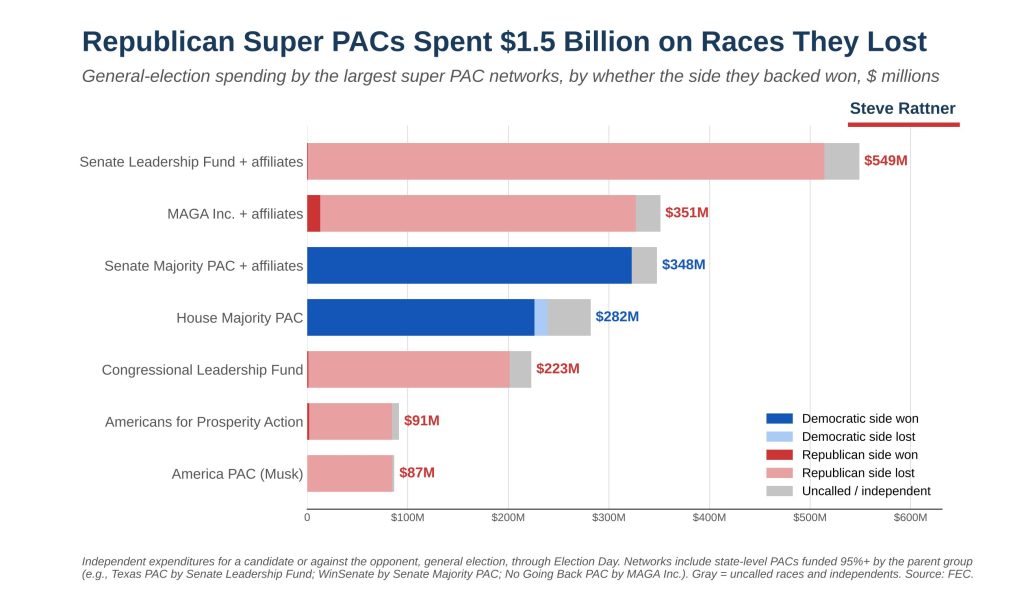
According to an analysis of Federal Election Commission data by financier and commentator Steve Rattner, Republican-aligned super PACs poured roughly $1.5 billion into general-election races they ultimately lost. The numbers raise an urgent question for modern democracy: when campaign cash collides with the price of groceries and gas, who actually holds the power?
In the high-stakes arithmetic of modern American elections, money has long been treated as the ultimate political solvent—capable of defining an opponent, saturating the airwaves, and manufacturing momentum out of thin air. Yet a striking visual breakdown of general-election independent expenditures through Election Day, compiled by Steve Rattner using Federal Election Commission filings, tells a far more sobering story for political financiers. Across the country’s largest super PAC networks, Republican-affiliated groups spent an estimated $1.5 billion backing candidates who lost, turning one of the largest coordinated cash deployments in history into a lopsided return on investment.
Look closely at the ledger, and the disparity between spending and winning becomes stark. The Senate Leadership Fund and its state-level affiliates—such as Texas PAC—deployed $549 million in general-election expenditures, nearly all of it shaded in the pale pink of defeat, with only a thin gray margin left in uncalled or independent contests and virtually nothing in the win column. MAGA Inc. and its affiliated networks, including No Going Back PAC, spent $351 million, yet only a narrow sliver of dark red represented victorious candidates alongside more than $300 million spent on losing efforts. The pattern repeated down the ballot: the Congressional Leadership Fund spent $223 million, Americans for Prosperity Action spent $91 million, and Elon Musk’s America PAC spent $87 million, each seeing the overwhelming majority of their funds go toward defeated candidates.
By contrast, the two largest Democratic super PAC networks operated on a smaller combined footprint while posting a dramatically different yield. The Senate Majority PAC and its affiliates, including WinSenate, spent $348 million, almost entirely concentrated in races the Democratic side won. House Majority PAC spent $282 million, likewise capturing victories across the vast majority of its targeted investments, with only a sliver of losses and a modest share remaining in uncalled races.
The Receipt at the Checkout Counter
Does a $1.5 billion loss mean political marketing is dead? Strategists across the ideological spectrum would argue it is not dead—but it has clearly hit a hard ceiling. Political advertising remains formidable in low-information primaries or down-ballot contests where voters know little about the names on the screen. In high-profile general elections, however, saturation quickly breeds immunity. By the final weeks of a campaign, voters in battleground states are so inundated with attack ads that the marginal dollar spent on television or digital media moves almost no one.
More fundamentally, no thirty-second spot can override a household’s weekly bank statement. When voters walk out of a grocery store or pull away from a gas pump feeling squeezed by the cost of basic necessities, messaging loses its persuasive power. Voters rarely dissect legislative scorecards or agency budgets; instead, they treat the everyday cost of living as a direct referendum on the party in power. In that environment, kitchen-table economics acts as a blunt instrument that billions in outside advertising cannot soften.
Opacity, Cynicism, and the Pull of the Center
That dynamic also exposes a deeper structural disconnect between Washington and the public. Most citizens have neither the time nor the inclination to track the mechanics of governance, and institutions often compound that distance through sheer opacity. From labyrinthine tax and regulatory codes to super PAC networks that funnel hundreds of millions of dollars through state-level affiliates, the machinery of politics frequently resembles a black box. When people feel locked out of how decisions are made and funded, skepticism toward both government and political messaging becomes the default setting.
In general elections, that skepticism tends to exert a gravitational pull toward the center. Hardline ideological movements—such as MAGA populism on the right—have proven remarkably effective at energizing primary electorates and attracting massive financial backing, as MAGA Inc.’s $351 million footprint demonstrates. Yet tactics and rhetoric that thrill a committed base can alienate the independent and moderate voters who decide general elections. When swing voters perceive a political movement as overly extreme, chaotic, or disconnected from pragmatic governance, they routinely recoil at the ballot box—even when that movement enjoys a massive financial advantage. Still, political observers note that a centrist tilt in a given cycle is less a permanent ideological realignment than a recurring correction whenever one faction pushes too far past the median voter.
Citizens United and the Representation Gap
Even when mega-donors suffer high-profile defeats, the underlying architecture of campaign finance remains untouched. More than a decade and a half after the Supreme Court’s Citizens United decision opened the floodgates to unlimited independent expenditures, the ability of a small tier of ultra-wealthy individuals and institutional networks to underwrite national campaigns is firmly entrenched. Look again at Rattner’s chart: whether the funds flowed through Senate Leadership Fund, MAGA Inc., Senate Majority PAC, or House Majority PAC, seven networks alone accounted for nearly $2 billion in general-election spending.
For many working- and middle-class Americans, that reality fuels a bipartisan disillusionment. Critics of the current system argue that while Republican super PACs absorbed the heavier losses in this cycle, both major parties remain deeply tethered to high-dollar donor ecosystems. As wealth concentration has widened and the middle class has felt increasingly squeezed, ordinary voters often conclude that neither populist nationalism nor establishment liberalism consistently delivers for regular households. In that view, the triumph of a more centrist slate over an unpopular incumbent movement offers a check against perceived extremism, yet still leaves average families wondering who truly represents their economic interests once the election ends.
The Long Slog Ahead
If history is any guide, the most realistic forecast for American politics is neither a sudden revolution nor a rapid collapse, but a continuation of incremental, hard-fought change measured in decades rather than election cycles. Divided power, narrow congressional majorities, and entrenched partisan incentives tend to produce gridlock punctuated by modest compromise.
Yet two inescapable fiscal realities loom over that familiar stalemate. First, the federal deficit continues to expand, pushing national borrowing costs higher and shrinking the room lawmakers have to respond to future economic downturns. Second, the long-projected shortfall in Social Security’s trust funds is steadily moving from a distant actuarial warning to an immediate legislative deadline, one that will eventually force Congress to confront painful choices over payroll taxes, benefit formulas, or retirement ages.
Ultimately, the $1.5 billion super PAC misfire offers a rare point of clarity in an otherwise murky political landscape. Money can buy attention, amplify grievances, and dominate the airwaves, but it cannot purchase immunity from economic reality or override the instincts of a skeptical electorate. For regular voters watching from the sidelines, a centrist course correction may feel like a modest win—proof that elections are still decided by ballots rather than balance sheets—even as the hardest work of making government transparent, solvent, and responsive to the middle class remains unfinished.