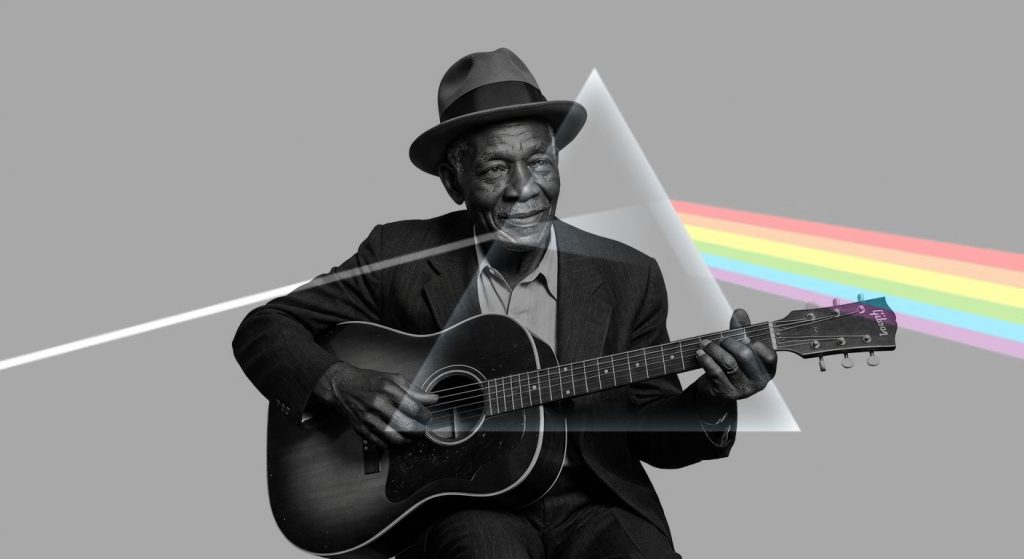
“By the way, which one’s pink?”
It’s one of the most famous, tongue-in-cheek lines in rock history, tossed off by a clueless record executive to members of Pink Floyd in a studio control room—as skewered on their 1975 track “Have a Cigar.” But long before multi-platinum stadium tours, floating pigs, and prism art, the answer to that question lived in the rural American South: Pink was a real man. Specifically, he was Pinkney “Pink” Anderson, a Piedmont blues trailblazer born in Laurens, South Carolina.
Roots in the Piedmont: The Birth of the Blues
To understand how Pink Anderson’s name traveled from the dusty crossroads of the Carolinas to the psychedelic vanguard of London, you have to look back at the birth of the Piedmont blues. Unlike the heavy bottleneck slide styles of the Mississippi Delta, the Piedmont blues style—flourishing through the 1920s and ’30s—featured a complex, alternating thumb-pick guitar technique that sounded almost like ragtime piano.
Pink Anderson mastered this intricate, rag-infused style alongside fellow Carolina bluesman Floyd Council. Traveling through the region as a fixture of medicine shows and street corners, Anderson brought a joyful, narrative energy to his music, recording sides for major labels like Columbia and Bluesway. Little did these early blues pioneers know, their names were destined to become immortalized across an ocean they would never cross.
Across the Atlantic: The British Invasion and the Blues Re-export
How did American blues make its way to England? In post-war Britain, American blues records were treated almost like sacred artifacts. Cargo ships docking in Liverpool and London ports carried imported vinyl, which quickly found its way into the hands of young, obsessively curious British art students and musicians.
Legends like Eric Clapton, Keith Richards, Jimmy Page, and a young generation of London-based mods and rockers poured over the recordings of Delta and Piedmont legends. They didn’t just listen to the blues—they dissected it, plugged it into high-wattage amplifiers, and cranked up the distortion. This cross-pollination sparked the British Invasion, where British bands took America’s native musical art form, supercharged it with rock-and-roll electricity, and sold it back to the world.
The Birth of Pink Floyd
Enter a fledgling London band in 1965. Originally calling themselves The Tea Set, the group—fronted by a visionary singer-songwriter named Syd Barrett—booked a gig only to discover another band with the exact same name was on the bill.
Facing an immediate identity crisis, Barrett pulled a record from his collection: a 1962 Blind Boy Fuller album featuring liner notes detailing various bluesmen. Impressed by the juxtaposition, Barrett plucked the first names of Pinkney “Pink” Anderson and Floyd Council, briefly styling the group as The Pink Floyd Sound before tightening it to Pink Floyd. The blues lineage was locked in stone, hidden in plain sight behind cosmic soundscapes and avant-garde light shows.
Home to the Blues: Spartanburg, South Carolina
While Pink Floyd went on to sell hundreds of millions of records worldwide, Pink Anderson spent his later years closer to home, passing away in October 1974. Today, his legacy—and the deep musical roots of the region—remains proudly preserved in Spartanburg, South Carolina.
If you ever find yourself tracing the roots of rock history in the Upcountry, Spartanburg offers a rich landscape for music lovers:
- The Spartanburg Music Trail: A self-guided, downtown walking tour that honors the area’s legendary musical sons and daughters. Here, you can find the plaque dedicated to Pink Anderson, celebrating his vital contribution to the global music lexicon alongside other local greats like The Marshall Tucker Band.
- Lincoln Memorial Gardens (Park): Located in Spartanburg, this is the final resting place of Pink Anderson. His gravesite features a distinctive, permanent headstone etched with an acoustic guitar—a quiet, powerful pilgrimage site for blues aficionados from all over the world.
- Local Soundscapes: From live music hubs and historic downtown venues hosting regional blues and roots acts to vibrant outdoor community spaces, Spartanburg embraces its heritage as an incubator of American music.
The next time you drop the needle on The Dark Side of the Moon or Wish You Were Here, remember that the spirit of a South Carolina bluesman is baked into the very DNA of the music. And if anyone ever asks you which one’s Pink, you’ll know exactly where to point them.